
Cleaning work for water treatment facilities
Cleaning work for water treatment facilities.
We undertake cleaning work for cooling towers, boilers, condensers, etc.
- Cooling tower cleaning work
- Steam outlet sparger cleaning work
- Boiler sandblasting work
We will introduce examples of the issues and solutions (cleaning methods) for the above.
Cooling tower cleaning work
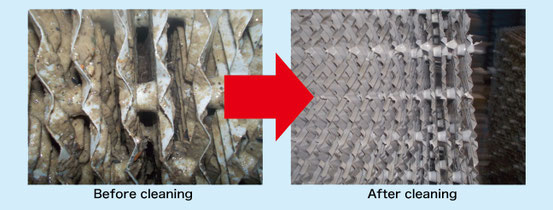
[Assignment content]
We received a consultation from a customer who was having trouble with the cooling tower's cooling capacity declining and the water temperature not reaching the target value. The problem was that scale and other sludge had accumulated in the filler, so even when the cooling fan was turned on, it was not able to take in outside air, and the sludge was blocking the falling water, preventing it from forming droplets and preventing the water temperature from dropping.
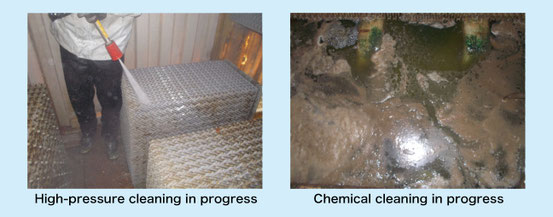
[Cleaning method]
First, the sludge was collected and analyzed in the laboratory. The analysis revealed that the sludge's main component was calcium carbonate. Therefore, the sludge components were removed and softened using chemical cleaning, and then high-pressure cleaning was performed. Since there was a large amount of sludge this time, the filler material was removed before high-pressure cleaning. As a result of this cleaning, the sludge was successfully removed and the cooling efficiency was successfully increased.

Steam outlet sparger cleaning work
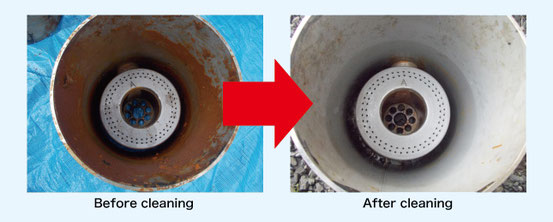
[Assignment content]
The steam outlet sparger (dispersion pipe) was clogged with scale, making it difficult for steam to escape. Until now, the company had been scraping off each thin pipe by hand using a screwdriver or needle, but this was time-consuming and labor-intensive, which was a problem for the company.
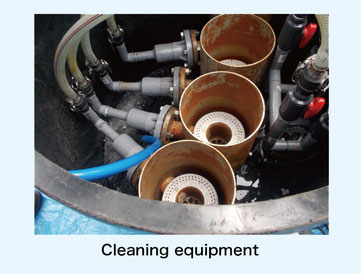
[Cleaning method]
We interviewed the customer in advance and created our own cleaning equipment to circulate chemicals all the way to the inside. In this case, we used our DAIWANOL A-200 for chemical cleaning. The chemicals penetrated into the thin tubes, which previously could not be reached by manual work, and were able to remove scale in a short time. Since we only needed to circulate the chemicals, we were also able to cut labor costs. The use of chemicals makes it possible to clean the inside of the tubes.
Boiler sandblast cleaning work
[Assignment content]
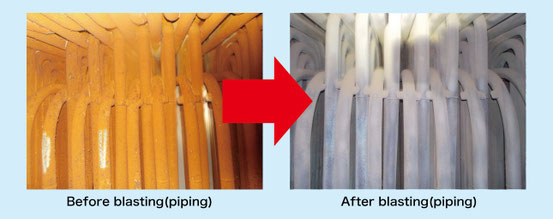
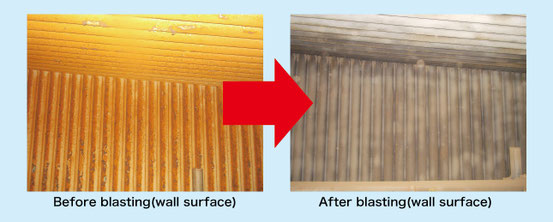
Scale buildup on boilers has reduced their thermal efficiency, and they want to remove the scale to improve it, but traditional manual descaling requires time and labor costs, and it is not possible to remove scale from hard-to-reach places, resulting in uneven removal. Water cleaning is difficult to implement because corrosion can progress if the scale is not thoroughly dried.
[Cleaning method]
We carried out sandblasting work, which involves hitting the scale with a special abrasive material using compressed air to remove it. Sandblasting is a dry method that does not contain moisture, so there is no need to worry about corrosion. As the abrasive is blown away with compressed air, it is possible to remove scale that cannot be reached by manual work. Compared to manual work, it can be removed in a shorter time, which has the advantage of reducing labor costs.
As your water treatment technology partner,
we will work together to solve water-related problems.
Please feel free to contact us using the orange button below .